Thank you for this extraordinary honor.
To receive a lifetime achievement award from the African Solar Industry Association is deeply meaningful to me. My work—and the work of We Care Solar—has always been rooted in partnership with African health workers, engineers, ministries of health, and communities who understand, more than anyone, what reliable energy means for human life.
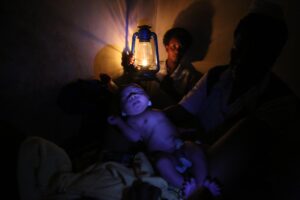
Nearly two decades ago, when I first witnessed childbirth in a Nigerian hospital without reliable electricity, I was shaken to my core. As an obstetrician from the United States, I had never imagined that a mother could reach a hospital in active labor—only to find darkness. Yet I watched midwives deliver babies and try to address obstetric complications by candlelight. I saw surgeries delayed or halted mid-procedure. I felt the fear of midwives as they searched for newborn resuscitation devices in the dark. And witnessed how expectant mothers arriving with life-threatening complications could be turned away from the hospital door – because the power was down.
It became painfully clear: one of the simplest tools in modern medicine—light—was missing from hundreds of thousands of health facilities. And because of that, mothers and newborns were losing their lives.
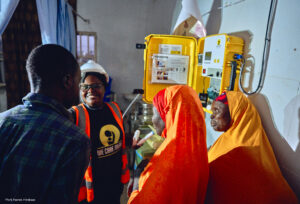
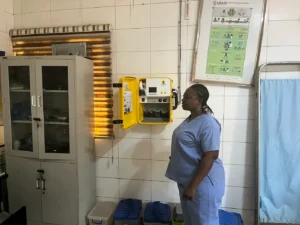
We founded We Care Solar to change this. Our idea was humble: a small, durable, portable solar electric system that could bring essential light and power to frontline health workers. We called it the Solar Suitcase. And thanks to extraordinary collaborators across Africa, it has traveled by truck, motorcycle, canoe—and human shoulders—to more than 11,000 health facilities.
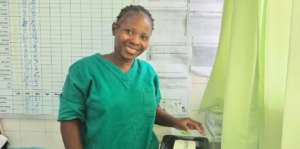
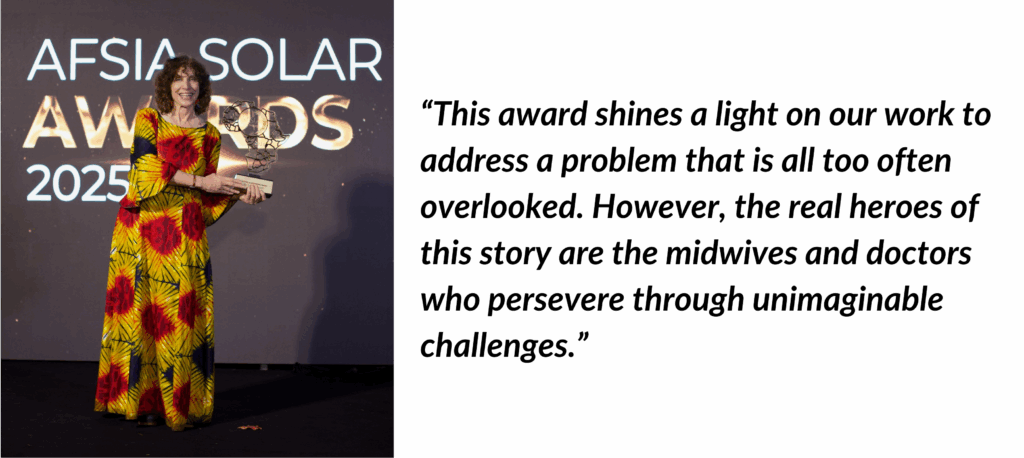
This award shines a light on our work to address a problem that is all too often overlooked. However, the real heroes of this story are the midwives and doctors who persevere through unimaginable challenges. They are the ones who now tell us, “I am no longer afraid to work at night,” or “This box you brought is a life-saver.” Their courage has fueled our commitment.
Standing here today, I am profoundly aware that this award recognizes something larger than one organization or one person. It celebrates a movement—one shared by all of you—rooted in three essential beliefs:
1. Every woman has the right to safe childbirth.
2. Every health worker is entitled to reliable, life-saving electricity.
3. Solar power is not just an environmental goal—it is a health intervention, a gender-equity tool, and a driver of human dignity.
Together, we have shown that solar power can reach the first mile—the clinics where health workers greet mothers at their most vulnerable moments. And we have shown that these solutions must be designed to last, supported by local capacity, and grounded in equity. I am especially proud of the women and youth who have become solar ambassadors, installers, and innovators—expanding what leadership in the energy sector looks like.
I want to acknowledge our incredible team – from Mozambique to Hawaii, our board, our partners across Africa, and the donors who believed small things could lead to very big things. And I especially thank my co-founder and life partner, Hal Aronson, whose vision and creativity helped turn an urgent need into a global solution.
This award is a reminder of what is possible when we combine innovation with justice—when sustainable energy becomes a lifeline for mothers and newborns. We have illuminated thousands of health facilities, serving 19 million mothers and newborns. But our work is not done.
No mother should ever give birth in the dark.
Not in this decade.
Not with the tools we now have.
I accept this award on behalf of all of you who are building an energy-secure Africa—and an energy-secure world. Together, we can ensure that every health worker has the power to save lives.
Thank you.