 We were in Malawi for three days when I asked a hospital midwife to tell me the word for pregnancy in Chichewa, the local language. “Pakati,” she told me. “What does that translate to?” I asked. “Between life and death.”
I looked at her soberly, taking in the significance of what she had just told me. In Malawi, as in so many parts of the developing world, pregnancy is indeed fraught with peril. In 2010, the WHO reported the Maternal Mortality Ratio (MMR) for Malawi was 470. That means that for every 100,000 live births, about 470 women will lose their lives. And my Malawi colleagues on this trip suggested the risk in rural areas is significantly higher. In fact, a young woman in Malawi faces a 1 in 36 lifetime risk of dying from pregnancy-related complications.[1]
When I was a practicing obstetrician in California, a big part of my job was to provide preventive care, identify and treat pregnancy complications as they arose, and ensure a joyful outcome for mother and baby. My pregnant patients had a lot of questions – about natural childbirth, the use of pain medication, the chances of needing a c/section, and so on – but never about the odds of survival. We all assumed that childbirth was an event to be celebrated, rather than one to be feared.
In Malawi, a healthy outcome is far from certain. For a rural woman, access to a decent health center is a significant challenge, often necessitating hours of travel by foot. Women in Malawi are encouraged to have at least four prenatal visits, compared to a minimum of eight visits for routine care in the United States. But at best, prenatal care identifies only a fraction of the complications that can occur in childbirth. The greatest threats to life: hemorrhage (excessive bleeding); obstructed labor (inability of the baby to fit through the birth canal); eclampsia (high blood pressure leading to convulsions); and sepsis (disseminated infection)– usually manifest close to the time of delivery. These conditions may not be preventable, but they are certainly treatable with proper medical and/or surgical care. They need not result in death. But appropriate treatment does require skilled clinicians capable of providing immediate emergency care.
The global Safe Motherhood movement now recognizes that emergency obstetric care – critical care that addresses the major complications of pregnancy – is an essential part of the package of health services that must be provided to every pregnant woman. In Malawi, community health workers and village leaders are called upon to encourage pregnant women to deliver in a health center. The law now forbids home births. This means that women must be able to reach functional health centers: facilities stocked with clean equipment, medical supplies, trained health providers, and something that is often overlooked – light.
On this trip to Malawi, we travel for hours to reach each clinic. As our four-wheel drive carefully maneuvers muddy dirt roads with deep trenches of water, I ask myself if I would choose to make the trip by foot if I were in labor. Would I be willing to leave the security of my home to arrive at a clinic shrouded in darkness? In Malawi, clinics lacking electricity expect women to bring their own candles and matches as part of their birthing kit. For a woman living in poverty, even the price of a candle can be a deterrent to obtaining skilled care.
So many women make a calculated risk. They stay home. They make the same choice their mothers made, and try and deliver by traditional means. They take their chances. And, in places like Malawi, where skilled health care is far and clinics are often in darkness, many of them are unable to obtain the care they need when problems arise. And pregnancy tragically does become a period of time “between life and death.”
I visited one health center in the middle of the night. Without my flashlight, I would not have been able to see my hand in front of my face. I look at the midwife in this health center with awe, imagining the courage it must take to come to work each night. I think about the thousands of babies I have delivered in the United States, and wonder how I could have functioned without the entire hospital infrastructure in place.
On this evening, the midwife shows me the only light available. She pulls her cell phone out of her pocket and shines a dim blue light in my direction. The battery is low, she explains. She shows me how she carefully sets the phone on a counter and points it in the direction of the delivery table six feet away. I can barely see the table. “How do you repair a laceration with this light?” “I don’t,” she apologizes, “I must wait for morning.”
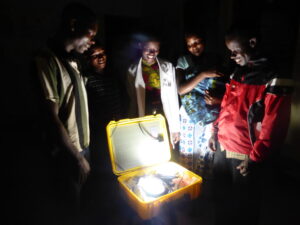
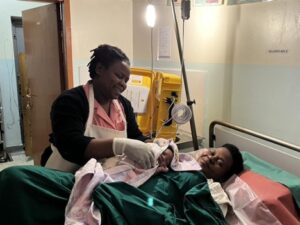
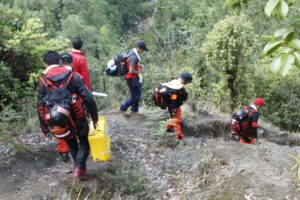
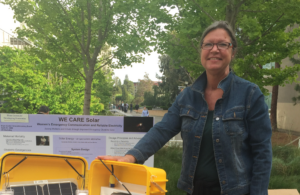
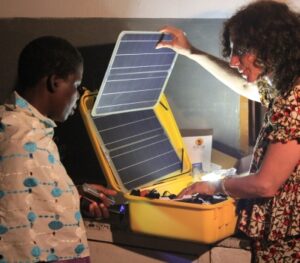
I pull out the bright yellow suitcase that is the reason for my visit. When I open it and turn on the lights, the room becomes visible again. And now Fanny has a wide smile on her face. She immediately realizes that she will no longer rely on cell phones or candles at night. That her cell phone can always be charged. That the fetal Doppler we include with the Solar Suitcase will make it easier for her to hear the fetal heart beat. “By the grace of God, you have come,” she tells me.
[1] That compares to a lifetime risk of dying in the U.S. of 1 in 2,400. In Britain the risk is 1 in 4800. (http://data.worldbank.org/indicator/SH.MMR.RISK, accessed 3/1/2013)